Quality and documentation

Quality you can check yourself.

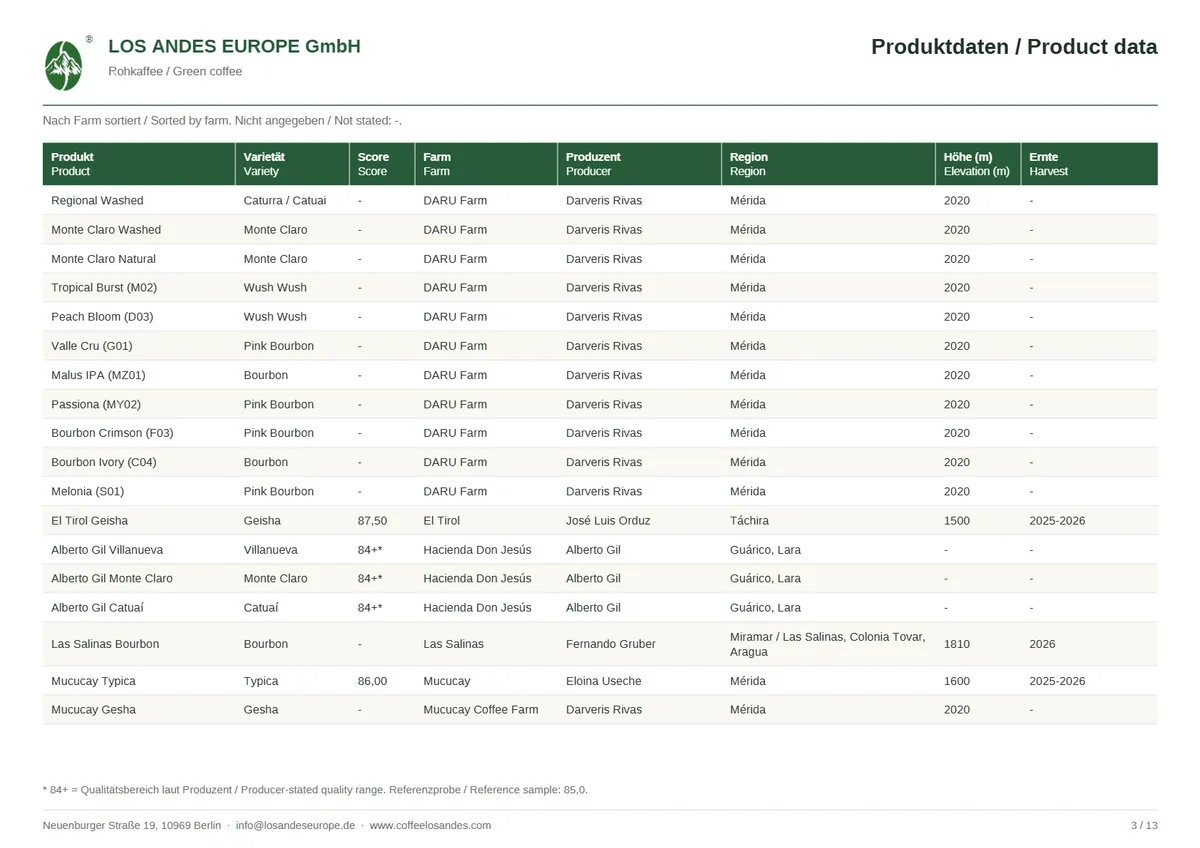
We document origin, processing, product data and samples per lot. Further documents are available on request.

Illustrative image

From harvest to quality.

Quality is made in working steps, long before a sample is cupped. The pictures show the working steps, not a photo record of one lot. Illustrative images are labelled as such.

  1. A hand picks ripe red coffee cherries from the branch

    Selective harvest

    The choice of cherries sets the raw material. Cherries are picked and sorted by ripeness.

  2. Two hands hold a refractometer for the °Brix reading

    Measuring ripeness

    A refractometer measures the °Brix of the cherry juice. It describes dissolved solids, not the sugar of the roasted bean.

  3. Two hands hold picked coffee cherries above a sack

    Processing

    Washed, natural and honey differ in when the fruit is removed. The five current lots are washed.

  4. Gloved hands turn parchment coffee with a wooden rake on a raised drying bed
    Illustrative image

    Drying

    While it dries, the coffee is turned until it is stable for storage.

  5. Gloved hands fill green coffee into a moisture meter, a water activity meter beside it
    Illustrative image

    Checking moisture

    Moisture and water activity show whether drying is complete. Both values appear in each of the seven test reports.

  6. Hands pick defective beans out of green coffee on a sorting table, screen sieves for bean size beside it
    Illustrative image

    Hulling and sorting

    After hulling, the coffee is sorted by size, density, colour and visible damage. Cupping completes the physical check.

In detail

From cherry to green coffee.

Natural and washed differ in when the fruit skin is removed. Fermentation does not replace selection: we state duration and conditions for a lot only where the producer’s protocol is on record.

The texts describe each method in general. What a producer documents for his coffees is given below with its source.

  • Washed After selection the cherries are pulped, the mucilage is removed by fermentation and washing depending on the method, then the coffee is dried. All five current lots are washed. Pulping · Photo: shoot of August 2026
  • Natural The cherries dry as whole fruit; the dried skin is removed during hulling. With Alberto Gil depending on the lot. Drying whole cherries · Café y Ciencia
  • Honey · Mérida Honey and experimental methods such as prolonged natural fermentation, ultrasonic, hops must or thermal shock are documented by Darveris Rivas for Café y Ciencia in Mérida. Cherries, DARU Farm, Mérida · Café y Ciencia
Processing explained
Checked before a lot travels.
Alberto Gil at quality control · Alberto Gil selection 2026

After drying and hulling the green coffee is cleaned and sorted by size, density, colour and visible damage. Because not every defect is visible, cupping complements the physical check.

  1. 01Hulling after drying
  2. 02Cleaning and sorting
  3. 03Judging the cup

From cherry to test report

Seven stations of quality.

Processing, drying, sorting, laboratory, sample roasting and cupping: what each station checks and what it delivers.

General description of the station. Values for a specific lot appear only in that lot’s report. Photographs show the producers’ work, not a photo record of every lot. Measured values apply only with their assigned report.

II Processing Stations 05 to 07 · At origin

Pulping machine with coffee cherries
Photo: shoot of August 2026Shows the work at origin, not a particular lot.

II · Processing

Station 5 of 14: Processing and fermentation

Washed, natural, honey and distinctive must processes shape the path from cherry to green coffee.

  1. InputSelected cherries or depulped coffee
  2. WorkLot-specific processing and fermentation when applicable
  3. OutputCoffee ready for its defined drying stage
Records and source

Processing describes what happens to the fruit layers. Fermentation describes the microbial transformation during one stage of it. The ten method names of the Café y Ciencia collection are explained one by one on its page, together with what the catalogue does not state about them.

What a record of this station can hold

  • Time, temperature and pH
  • Vessel, atmosphere and substrates
  • Transition from the end of fermentation to the start of drying

Fermentation time, temperature and protocol are not stated for any lot. Washed or natural does not imply a particular recipe.

Source: Café y Ciencia catalogue

Read on: Café y Ciencia · Natural, washed and honey, explained

Gloved hands turning parchment coffee with a wooden rake on raised drying beds
Illustrative image (AI visualisation)Illustrates the step, not a photograph taken at origin.

II · Processing

Station 6 of 14: Drying

Drying brings processed coffee to a condition suitable for storage.

  1. InputCherries or parchment coffee with variable moisture
  2. WorkManaged moisture removal and regular checks
  3. OutputDried coffee with checked moisture and water activity
Records and source

The Café y Ciencia catalogue shows coffee on drying surfaces under a roof. Layer depth, turning, airflow and weather shape the process. Final moisture and water activity are measured separately; an even course helps to avoid different moisture levels within one lot. Beans that are too wet or have been rewetted can grow mould.

What a record of this station can hold

  • Date, weather and layer depth
  • Final moisture in % and water activity
  • Stabilisation and separate storage of lots

The catalogue gives no drying time or series of measurements. Measured moisture and water activity are shown with the reports of the individual samples.

Source: Café y Ciencia catalogue; analysis reports in the laboratory register; FAO, Arabica coffee manual

Read on: Natural, washed and honey, explained

Hands picking defective beans out of green coffee on a sorting table
Illustrative image (AI visualisation)Illustrates the step, not a photograph taken at origin.

II · Processing

Station 7 of 14: Hulling and sorting

After removing dried fruit layers or parchment, green coffee is sorted.

  1. InputDried coffee
  2. WorkHulling, sieving and removal of unwanted material
  3. OutputSorted green coffee sample
Records and source

Size, density, colour and visible defects are different sorting criteria, checked by screening, physical separation or visual selection. Alberto Gil’s selection describes how, after drying and hulling, the green beans are checked again for defects, broken beans and foreign matter. Badly adjusted machines can damage beans.

What a record of this station can hold

  • Screen distribution in %
  • Defects by type, count and equivalents
  • Colour, smell and uniformity

Sorting data from one sample do not apply to other coffees.

Source: Alberto Gil selection 2026, p. 9; FAO, Arabica coffee manual

Read on: Checked cherry by cherry. · Natural, washed and honey, explained

III Testing and cupping Stations 08 to 11 · In the lab

Hands holding a cup of green coffee in the lab, a meter beside it
Photo: Café y Ciencia catalogueShows the work at origin, not a particular lot.

III · Testing and cupping

Station 8 of 14: Physical laboratory

Moisture, water activity, density, screen distribution and defects describe the physical sample.

  1. InputIdentified green coffee sample
  2. WorkPhysical tests using documented methods
  3. OutputMeasurement report with units and test conditions
Records and source

Every measurement needs an unambiguous sample and lot number; test date, method, instrument and conditions make the result traceable. The Typica report signed by Darveris Rivas names as methods ISO standards, the Venezuelan standard COVENIN 1338-86 for sampling and the 2003 SCAA cupping protocol. These are test methods, not a certification.

What a record of this station can hold

  • Moisture in %, with method and date
  • Water activity and measuring temperature
  • Bulk density in g/L
  • Screen shares in % and test mass in g

A photograph of the laboratory proves neither an accreditation nor a type of instrument.

Source: Analysis report Typica, Finca Mucucay, 26.01.2026

Read on: Test reports on samples

Laboratory glassware with green coffee samples and instruments on a bench
Illustrative image (AI visualisation)Illustrates the step, not a photograph taken at origin.

III · Testing and cupping

Station 9 of 14: Chemical laboratory

Sugars, caffeine, pH and other constituents require chemical analysis.

  1. InputDefined sample: green, roasted or cherry juice
  2. WorkChemical determination of selected parameters
  3. OutputAnalytical values with method and reporting basis
Records and source

Darveris Rivas is a co-author of a study published in 2025 on three coffees from Mérida at different roast levels. It examined ash, crude fibre, caffeine, pH, fat and sugars as well as sensory quality. For a delivered coffee, every value needs its sample type, method, reference basis and unit; a value from roasted coffee is not a green coffee or cherry juice value. pH and perceived acidity are different statements.

What a record of this station can hold

  • Total sugar or individual sugars, with method
  • Caffeine and fat in % or mg/g
  • pH and acid content kept apart
  • Ash, crude fibre and analyses as required

The study is not an analysis of the coffees on offer. No lot related chemical values are available.

Source: Zerpa, Rivas, Hernández, Zambrano, Ciencia e Ingeniería 46 (2), 2025, DOI 10.5281/zenodo.15320514

Read on: Café y Ciencia · Acidity, body and finish, explained

The trier of a sample roaster with freshly roasted beans
Photo: Café y Ciencia catalogueShows the work at origin, not a particular lot.

III · Testing and cupping

Station 10 of 14: Sample roasting

Sample roasting provides a documented basis for sensory evaluation.

  1. InputGreen coffee sample
  2. WorkDocumented sample roast and cooling
  3. OutputComparable roasted sample for tasting
Records and source

A roast record can hold roast date, machine, batch size, time and temperature curve, first crack, end point, colour and weight loss. Comparable sample roasts help to judge coffees against each other. A roastery’s production profile comes later, for its machine, its batch size and the intended use.

What a record of this station can hold

  • Time, temperature and first crack
  • Colour and weight loss in %
  • Roast and cupping date

The documents on record contain no measured roast curve.

Source: Café y Ciencia catalogue

Read on: How roasters select green coffee

Cupping bowls, spoons and sample bags on a tasting table
Illustrative image (AI visualisation)Illustrates the step, not a photograph taken at origin.

III · Testing and cupping

Station 11 of 14: Cupping and evaluation

Aroma, flavour, acidity, mouthfeel and aftertaste describe the sensory experience of coffee.

  1. InputDocumented roasted sample
  2. WorkConsistent preparation and sensory assessment
  3. OutputCup description and, when available, a sample-linked score
Records and source

Cupping links a documented sample roast and preparation with a sensory evaluation. Score, cupper, date and protocol belong to the sample in question. The reports on record use two forms: Typica and Grupo MVC ten classic attributes, El Tirol, Brisas del Gil, Castillo and Festival eight affective attributes. Sensory sweetness is not an analytical sugar value.

What a record of this station can hold

  • Format, version and date of the protocol
  • Aroma, acidity, body and aftertaste
  • Score only with an assigned sample

The reports do not state the protocol version. Competition points belong to the competition coffee. How to read a score is explained in the knowledge article on segment and cup score.

Source: Analysis reports in the laboratory register; SCA, Coffee Value Assessment

Read on: Product segment and individual cup score · Test reports on samples

Sensory profile and scores.

Points, measured values and aromas, as the catalogue and the test reports state them. Every value belongs to its source.

Cupping score of the five current lots

The points of our current lots refer to the cupping scale up to 100. Check the coffee yourself: samples of every current lot are available on request.

  1. Geisha “El Tirol” 87.5
  2. Castillo “Colonia Tovar” 85.5
  3. “Brisas del Gil” 85.0
  4. “Festival Colonia Tovar” 84.25
  5. “Grupo MVC” 79.0

80 points is the traditional market convention for specialty: a guide, not a testing standard.

Source: B2B catalogue 2026 · Cupping score

Physical values of the samples

Physical and sensory reports exist for the current lots and for a Typica from Mérida. The values apply only to the submitted sample; they are not a permanent rating of a product.

  1. José Luis Orduz · El Tirol

    Geisha El Tirol

    Táchira

    87.5 Points in the format of the respective report

    Classification per report: Specialty

    Moisture
    11.0 %
    Water activity
    0.60
    Density
    800 g/L
    Analysis
    Jun 3, 2026
    Sample code
    VTC002
    Analyst
    Juan José García
    To the lot: Geisha El Tirol
  2. Castillo Colonia Tovar

    Colonia Tovar, Aragua

    85.5 Points in the format of the respective report

    Moisture
    11.4 %
    Water activity
    0.63
    Density
    800 g/L
    Analysis
    May 11, 2026
    Report
    001-05-2026
    Analyst
    Mirla Segovia
    To the lot: Castillo Colonia Tovar
  3. Asociación Civil Productores de Café Brisas del Gil

    Brisas del Gil

    Guárico, Lara

    85.0 Points in the format of the respective report

    Classification per report: Specialty

    Moisture
    10.0 %
    Water activity
    0.66
    Density
    691 g/L
    Analysis
    Dec 12, 2025
    Report
    001-12-Fecvelab-2025
    Analyst
    Mirla Segovia
    To the lot: Brisas del Gil
  4. Festival Colonia Tovar

    Colonia Tovar, Aragua

    84.25 Points in the format of the respective report

    Moisture
    11.8 %
    Water activity
    0.66
    Density
    800 g/L
    Analysis
    May 11, 2026
    Report
    002-05-2026
    Analyst
    Mirla Segovia
    To the lot: Festival Colonia Tovar
  5. Eloina Useche · Finca Mucucay

    Typica, Finca Mucucay

    Mérida

    86.00 Points in the format of the respective report

    Moisture
    11.7 %
    Water activity
    0.65
    Density
    700 g/L
    Analysis
    Jan 26, 2026
    Report
    0001
    Analyst
    Lcdo. Darveris Rivas
  6. Grupo MVC 2024, C.A.

    Grupo MVC

    not stated

    79.0 Points in the format of the respective report

    Classification per report: not specialty

    Moisture
    11.7 %
    Water activity
    0.66
    Density
    660 g/L
    Analysis
    Nov 6, 2025
    Report
    003-11-Fecvelab-2025
    Analyst
    Mirla Segovia
    To the lot: Grupo MVC
How to read segment and cup score

Documented aromas

Four lots with named aromas. Colour marks the aroma family, not its intensity.

  1. Geisha “El Tirol”B2B catalogue 2026
  2. Castillo “Colonia Tovar”B2B catalogue 2026
  3. “Brisas del Gil”Test report of the sample
  4. “Festival Colonia Tovar”Test report of the sample

Taste map

Geisha “El Tirol”

Documented aroma families

not named Citrus, Sweetness, Cocoa, Nut, Spice and herbs, Liqueur, Creamy, Overall impression

Geisha “El Tirol”

B2B catalogue 2026

  • Floral
  • Fruity

Taste map

Castillo “Colonia Tovar”

Documented aroma families

not named Fruit, Citrus, Floral, Sweetness, Nut, Spice and herbs, Liqueur, Creamy, Overall impression

Castillo “Colonia Tovar”

B2B catalogue 2026

  • Chocolatey
  • Clear acidity

Taste map

“Brisas del Gil”

Documented aroma families

not named Citrus, Floral, Nut, Spice and herbs, Liqueur, Creamy, Overall impression

“Brisas del Gil”

Test report of the sample

  • Fruity
  • Green apple
  • Cocoa
  • Caramel
  • Juicy acidity

Taste map

“Festival Colonia Tovar”

Documented aroma families

not named Fruit, Citrus, Cocoa, Nut, Spice and herbs, Liqueur, Creamy, Overall impression

“Festival Colonia Tovar”

Test report of the sample

  • Floral
  • White flowers
  • Caramel
  • Molasses

Grupo MVC: the descriptive statements of its test report are on the lot page.

Laboratory and test reports.

All documents on quality and origin in one place: who produced them, when and what they apply to.

Technical data 2

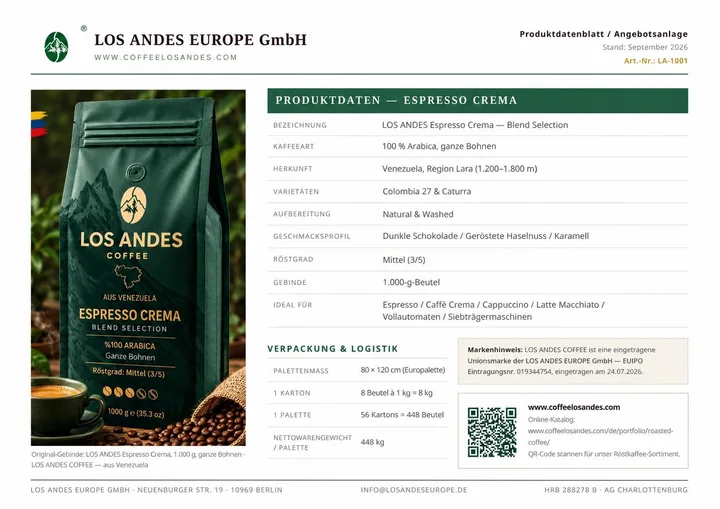
  1. Preview: Product data sheet Espresso Crema 1 kg

    Technical data sheet About this product

    Product data sheet Espresso Crema 1 kg

    1,000 g, whole beans

    Ref. LA‑1001 · September 2026 · German

    Attribution: Espresso Crema

    Publisher
    LOS ANDES EUROPE GmbH
    September 2026
    Source
    Producer’s statement, not independently verified

    View document: Product data sheet Espresso Crema 1 kg Request this document: Product data sheet Espresso Crema 1 kg

    In detail: Product data sheet Espresso Crema 1 kg

    Refers to exactly this profile.

    Product data, packaging and logistics per carton and pallet.

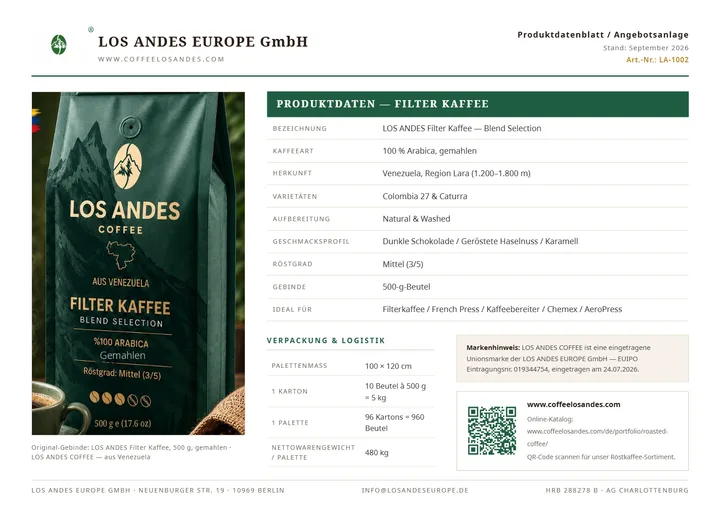
  2. Preview: Product data sheet Filter Coffee 500 g

    Technical data sheet About this product

    Product data sheet Filter Coffee 500 g

    500 g, ground

    Ref. LA‑1002 · September 2026 · German

    Attribution: Filter Coffee

    Publisher
    LOS ANDES EUROPE GmbH
    September 2026
    Source
    Producer’s statement, not independently verified

    View document: Product data sheet Filter Coffee 500 g Request this document: Product data sheet Filter Coffee 500 g

    In detail: Product data sheet Filter Coffee 500 g

    Refers to exactly this profile.

    Product data, packaging and logistics per carton and pallet.

Laboratory and analyses 6

Physical and sensory reports exist for the current lots and for a Typica from Mérida. The values apply only to the submitted sample; they are not a permanent rating of a product.

  1. Test report About a lot

    Geisha El Tirol

    Quality report, physical and sensory analysis

    Attribution: Geisha “El Tirol” · José Luis Orduz · El Tirol

    Applies only to the tested sample.

    Analysed by
    Juan José García
    June 3, 2026
    Origin
    Táchira, 1,500 m

    87.5Points

    To the lot: Geisha El Tirol

    View analysis values: Geisha El Tirol
    Moisture
    11.0 %
    Water activity
    0.60
    Density
    800 g/L
    Defects I · II
    0 · 0

    Sensory values per report

    Fragrance
    6
    Aroma
    7
    Flavour
    6
    Aftertaste
    7
    Acidity
    7
    Mouthfeel
    7
    Sweetness
    6
    Overall impression
    7

    Values as printed in the report, on the scale of its form. They apply only to the submitted sample.

    Classification per report: Specialty

    Sample code
    VTC002
    Analyst
    Juan José García
    Harvest
    2025/2026
    Points
    Points in the format of the respective report

    Restriction Applies to the analysed sample. The report contains personal contact data and is not published.

  2. Test report About a lot

    Typica, Finca Mucucay

    Resultado de análisis, SCA format 0001

    Attribution: Typica, Finca Mucucay · Eloina Useche · Finca Mucucay

    Applies only to the tested sample.

    Analysed by
    Lcdo. Darveris Rivas
    January 26, 2026
    Origin
    Mérida, 1,600 m

    86.00Points

    View analysis values: Typica, Finca Mucucay
    Moisture
    11.7 %
    Water activity
    0.65
    Density
    700 g/L
    Defects I · II
    0 · 3

    Sensory values per report

    Fragrance and aroma
    8.25
    Flavour
    8
    Aftertaste
    7.75
    Acidity
    8
    Body
    8
    Balance
    8
    Uniformity
    10
    Clean cup
    10
    Sweetness
    10
    Cupper’s score
    8

    Values as printed in the report, on the scale of its form. They apply only to the submitted sample.Classic form: ten attributes on a scale of 10; their sum is the total score.

    The report names ISO standards for sampling, moisture, density, screen analysis and defects, the Venezuelan standard COVENIN 1338-86 for sampling and the 2003 SCAA cupping protocol. These are test methods, not a certification or an accreditation. ISO 3509:2005 · ISO 4072:1982 · ISO 4149:2005 · ISO 6673:2003 · ISO 2395:1990 · ISO 4150:1991 · ISO 4150:2011 · ISO 6669:1995 · ISO 6668:2008 · ISO 1447:1978 · ISO 6667:1985

    Report
    0001
    Analyst
    Lcdo. Darveris Rivas
    Harvest
    2025/2026
    Points
    Points in the format of the respective report

    Restriction According to the report, valid only for the submitted sample and for 60 days. The report itself is not published.

  3. Test report About a lot

    Castillo Colonia Tovar

    Informe de ensayo, SCA format 001-05-2026

    Attribution: Castillo “Colonia Tovar”

    Applies only to the tested sample.

    Analysed by
    Mirla Segovia
    May 11, 2026
    Origin
    Colonia Tovar, Aragua, 1,800 m

    85.5Points

    To the lot: Castillo Colonia Tovar

    View analysis values: Castillo Colonia Tovar
    Moisture
    11.4 %
    Water activity
    0.63
    Density
    800 g/L
    Defects I · II
    10 · 24

    Sensory values per report

    Fragrance
    6
    Aroma
    6
    Flavour
    6
    Aftertaste
    6
    Acidity
    7
    Sweetness
    6
    Mouthfeel
    7
    Overall impression
    6

    Values as printed in the report, on the scale of its form. They apply only to the submitted sample.

    Report
    001-05-2026
    Analyst
    Mirla Segovia
    Harvest
    2025
    Points
    Points in the format of the respective report

    Restriction According to the report, valid only for the submitted sample; the laboratory did not take the sample and does not confirm its origin; reproduction prohibited. The report itself is not published.

  4. Test report About a lot

    Brisas del Gil

    Informe de ensayo, SCA format 001-12-Fecvelab-2025

    Attribution: “Brisas del Gil” · Asociación Civil Productores de Café Brisas del Gil

    Applies only to the tested sample.

    Analysed by
    Mirla Segovia
    December 12, 2025
    Origin
    Guárico, Lara

    85.0Points

    To the lot: Brisas del Gil

    View analysis values: Brisas del Gil
    Moisture
    10.0 %
    Water activity
    0.66
    Density
    691 g/L
    Defects I · II
    0 · 0

    Sensory values per report

    Fragrance
    6
    Aroma
    6
    Flavour
    6
    Aftertaste
    6
    Acidity
    7
    Sweetness
    6
    Mouthfeel
    6
    Overall impression
    6

    Values as printed in the report, on the scale of its form. They apply only to the submitted sample.

    Classification per report: Specialty

    Report
    001-12-Fecvelab-2025
    Analyst
    Mirla Segovia
    Harvest
    2025/2026
    Points
    Points in the format of the respective report

    Restriction According to the report, valid only for the submitted sample; the laboratory did not take the sample and does not confirm its origin; reproduction prohibited. The report itself is not published.

  5. Test report About a lot

    Festival Colonia Tovar

    Informe de ensayo, SCA format 002-05-2026

    Attribution: “Festival Colonia Tovar”

    Applies only to the tested sample.

    Analysed by
    Mirla Segovia
    May 11, 2026
    Origin
    Colonia Tovar, Aragua, 1,800 m

    84.25Points

    To the lot: Festival Colonia Tovar

    View analysis values: Festival Colonia Tovar
    Moisture
    11.8 %
    Water activity
    0.66
    Density
    800 g/L
    Defects I · II
    29 · 8

    Sensory values per report

    Fragrance
    6
    Aroma
    6
    Flavour
    6
    Aftertaste
    6
    Acidity
    6
    Sweetness
    6
    Mouthfeel
    6
    Overall impression
    6

    Values as printed in the report, on the scale of its form. They apply only to the submitted sample.

    Report
    002-05-2026
    Analyst
    Mirla Segovia
    Harvest
    2025
    Points
    Points in the format of the respective report

    Restriction According to the report, valid only for the submitted sample; the laboratory did not take the sample and does not confirm its origin; reproduction prohibited. The report itself is not published.

  6. Test report About a lot

    Grupo MVC

    Informe de ensayo, SCA format 003-11-Fecvelab-2025

    Attribution: “Grupo MVC” · Grupo MVC 2024, C.A.

    Applies only to the tested sample.

    Analysed by
    Mirla Segovia
    November 6, 2025
    Origin
    not stated

    79.0Points

    To the lot: Grupo MVC

    View analysis values: Grupo MVC
    Moisture
    11.7 %
    Water activity
    0.66
    Density
    660 g/L
    Defects I · II
    2 · 4

    Sensory values per report

    Fragrance and aroma
    6.75
    Flavour
    7
    Aftertaste
    7
    Acidity
    7
    Mouthfeel
    6.75
    Balance
    7.25
    Uniformity
    10
    Clean cup
    10
    Sweetness
    10
    Cupper’s score
    7.25

    Values as printed in the report, on the scale of its form. They apply only to the submitted sample.Classic form: ten attributes on a scale of 10; their sum is the total score.

    Classification per report: not specialty

    Report
    003-11-Fecvelab-2025
    Analyst
    Mirla Segovia
    Harvest
    not stated
    Points
    Points in the format of the respective report

    Restriction According to the report, valid only for the submitted sample; the laboratory did not take the sample and does not confirm its origin; reproduction prohibited. The report itself is not published.

How to read the reports
  • The reports do not state the protocol version. Older scores are not called results of today’s Coffee Value Assessment.
  • Reports on the newer form show eight affective values. They are not added up; the final score of the report is shown.
  • Physical defects and sensory faults are separate checks. Count and defect equivalents are two different figures.
  • Where a report gives no individual scores, they are not calculated from the total.

Awards and competition results 11

Four entries to the Venezuelan quality competition EICEV 2025 that we list as a reference. They show the result of the respective producer, not a certificate and not an assessment by LOS ANDES EUROPE. View the competition references

  1. Competition

    EICEV 2025

    Geisha

    Producer: Eloína de los Ángeles Useche

    Source: Official result list

    Result of the coffee entered in the competition, not a current delivery batch.

    91.54Points

  2. Competition

    EICEV 2025

    Geisha

    Producer: Ricardo J. Lozada M.

    Source: Official result list

    Result of the coffee entered in the competition, not a current delivery batch.

    91.03Points

  3. Competition

    EICEV 2025

    Tabi

    Producer: Roney Antonio Durán Mejía

    Source: Official result list

    Result of the coffee entered in the competition, not a current delivery batch.

    90.38Points

  4. Competition

    EICEV 2025

    Geisha

    Producer: Eloína de los Ángeles Useche

    Source: Official result list

    Result of the coffee entered in the competition, not a current delivery batch.

    90.30Points

More documents from Café y Ciencia 7
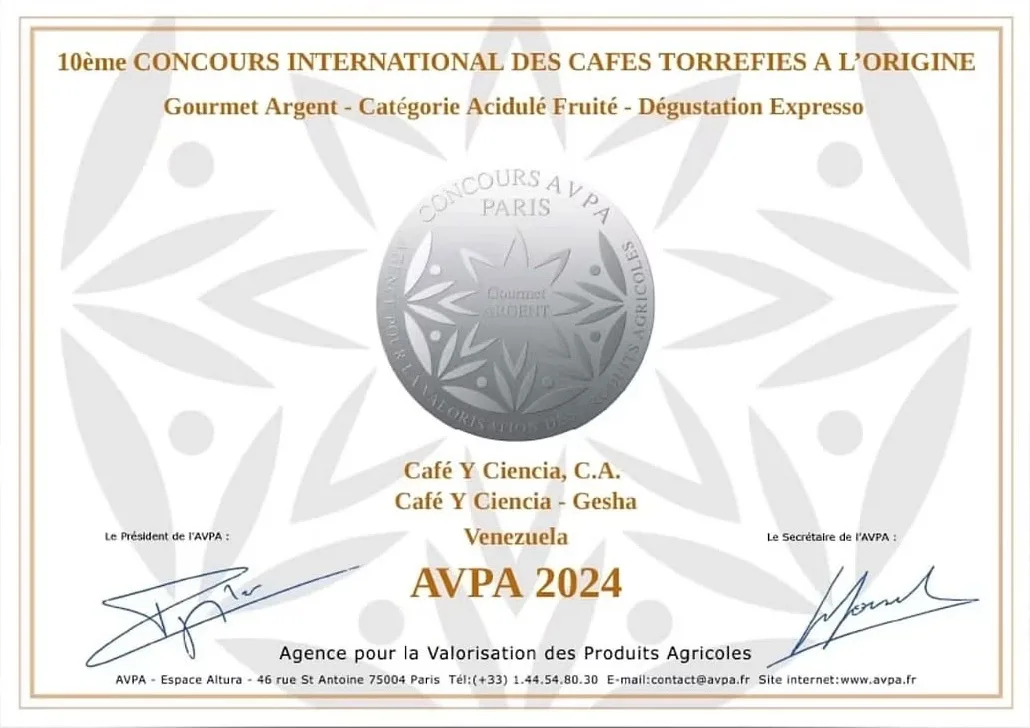
  1. Preview: AVPA 2024 · Gourmet Argent · Gesha

    Competition certificate Producer and farm

    AVPA 2024 · Gourmet Argent · Gesha

    Attribution: Café y Ciencia · Café Y Ciencia, C.A.

    Organiser
    AVPA Paris
    2024
    Source
    Checked against the official list on October 11, 2026

    View document: AVPA 2024 · Gourmet Argent · Gesha Request this document: AVPA 2024 · Gourmet Argent · Gesha

    In detail: AVPA 2024 · Gourmet Argent · Gesha

    Shows the producer or a competition coffee with the same name, not this profile.

  2. Official result list Producer and farm

    12e Concours International des Cafés torréfiés à l’origine

    Attribution: Café y Ciencia

    Organiser
    AVPA Paris
    2026
    Source
    Checked against the official list on October 11, 2026

    Open source: 12e Concours International des Cafés torréfiés à l’origine

    In detail: 12e Concours International des Cafés torréfiés à l’origine

    Shows the producer or a competition coffee with the same name, not this profile.

  3. Official result list Producer and farm

    11e Concours International des Cafés torréfiés à l’origine

    Attribution: Café y Ciencia

    Organiser
    AVPA Paris
    2025
    Source
    Checked against the official list on October 11, 2026

    Open source: 11e Concours International des Cafés torréfiés à l’origine

    In detail: 11e Concours International des Cafés torréfiés à l’origine

    Shows the producer or a competition coffee with the same name, not this profile.

  4. Official result list Producer and farm

    10e Concours International des Cafés torréfiés à l’origine

    Attribution: Café y Ciencia

    Organiser
    AVPA Paris
    2024
    Source
    Checked against the official list on October 11, 2026

    Open source: 10e Concours International des Cafés torréfiés à l’origine

    In detail: 10e Concours International des Cafés torréfiés à l’origine

    Shows the producer or a competition coffee with the same name, not this profile.

  5. Official result list Producer and farm

    9e Concours International des Cafés torréfiés à l’origine

    Attribution: Café y Ciencia

    Organiser
    AVPA Paris
    2023
    Source
    Checked against the official list on October 11, 2026

    Open source: 9e Concours International des Cafés torréfiés à l’origine

    In detail: 9e Concours International des Cafés torréfiés à l’origine

    Shows the producer or a competition coffee with the same name, not this profile.

  6. Official result list Producer and farm

    8e Concours International des Cafés torréfiés à l’origine

    Attribution: Café y Ciencia

    Organiser
    AVPA Paris
    2022
    Source
    Checked against the official list on October 11, 2026

    Open source: 8e Concours International des Cafés torréfiés à l’origine

    In detail: 8e Concours International des Cafés torréfiés à l’origine

    Shows the producer or a competition coffee with the same name, not this profile.

  7. Official result list Producer and farm

    World Coffee Challenge 2023 · Official results

    Attribution: Café y Ciencia

    Organiser
    World Coffee Challenge
    2023
    Source
    Checked against the official list on October 11, 2026

    Open source: World Coffee Challenge 2023 · Official results

    In detail: World Coffee Challenge 2023 · Official results

    Shows the producer or a competition coffee with the same name, not this profile.

Original sources 3

  1. Preview: CATÁLOGO · Café y Ciencia

    Product catalogue Collection

    CATÁLOGO · Café y Ciencia

    Attribution: Café y Ciencia · Darveris Rivas

    Publisher
    Café y Ciencia (Darveris Rivas)
    Source
    Producer’s statement, not independently verified

    View document: CATÁLOGO · Café y Ciencia Request this document: CATÁLOGO · Café y Ciencia

    In detail: CATÁLOGO · Café y Ciencia

    Applies to the whole collection, not as proof for a single lot.

  2. Product catalogue Collection

    Specialty-Rohkaffee-Auswahl 2026, Alberto Gil

    Attribution: Whole collection · Alberto Gil

    Publisher
    LOS ANDES EUROPE GmbH
    2026
    Source
    Producer’s statement, not independently verified
    In detail: Specialty-Rohkaffee-Auswahl 2026, Alberto Gil

    Applies to the whole collection, not as proof for a single lot.

  3. Preview: Bestellformular / Order form · Rohkaffee / Green coffee

    Product catalogue Collection

    Bestellformular / Order form · Rohkaffee / Green coffee

    Attribution: Whole collection

    Publisher
    LOS ANDES EUROPE GmbH
    2026
    Source
    Producer’s statement, not independently verified

    View document: Bestellformular / Order form · Rohkaffee / Green coffee

    In detail: Bestellformular / Order form · Rohkaffee / Green coffee

    Applies to the whole collection, not as proof for a single lot.

Documents on request

We provide product data sheets, catalogues and quality documentation individually on request. Their details are on this page.

View in the browser. We provide the original on request.

What we document.

Three states, each detail with its basis.

The information on our lots is based on LOS ANDES’ current product, origin and quality documentation and on the respective producer and test records.

Documented

Backed by a source and readable here.

  • Origin per lot on every lot page
  • Processing the five current lots washed
  • Roasted coffee product data product data sheet LA‑1001, September 2026
  • Points cupping score per lot
  • Delivery terms and packaging EXW, CFR/CIF, DAP; 60 kg sacks with GrainPro

On request

Provided for your lot.

  • Samples samples of every current lot

Only with complete evidence

We publish these only with complete details. Questions about a lot are answered on request.

  • Cupping protocols with date, cupper and lot attribution
  • Laboratory analyses with issuer, date, scope and lot attribution
  • Certifications with issuer, scope and validity

The most important check happens with you.

  1. 01

    Choose a lot

    Compare origin, processing and cupping score.

    Lot
    A defined batch of coffee with a common origin and processing.
    Washed
    The fruit pulp is removed before drying, and the bean is washed.
    Natural
    The whole cherry dries before the bean is taken out.
  2. 02

    Request a sample

    For every current lot, with your use and your volume.

  3. 03

    Roast and taste

    With your roast profile and your own method.

  4. 04

    Decide

    Based on your own check, not on the cupping score alone.

  5. 05

    Agree the offer

    Volume, delivery terms and packaging for your lot.

    GrainPro
    A tight inner bag inside the jute sack; we deliver in 60 kg sacks with GrainPro.
    EXW, CFR/CIF, DAP
    Delivery terms (Incoterms). We supply EXW Venezuela, CFR/CIF or DAP Germany.