Venezuelan coffee

Why coffee from the Venezuelan Andes is worth a roaster’s and a trader’s attention, and how it travels from the farm to your enquiry in Europe.

View the current lots

AI visualisation based on a drone photograph taken in Venezuela on 24 August 2026. Not original footage.

Many farms. Many stories. One origin.

Venezuelan coffee is not the story of a single producer. Behind the lots are families, farms and producers from several regions of the country.

Archived reference profiles come from 9 states.

Current harvest 2025/26

José Luis Orduz

El Tirol · Táchira

Producer of the Geisha “El Tirol” from the current harvest: a limited micro-plot in Táchira at 1,500 m.

Current harvest 2025/26Producer partner

Alberto Gil

Hacienda Don Jesús · Lara

The Gil family has grown coffee for five generations, on Hacienda Don Jesús in Guárico, Lara: five varieties, natural or washed depending on the lot. The family is connected with the producers’ association Brisas del Gil; the current lot bears the name “Brisas del Gil”.

Café y Ciencia

Darveris Rivas

DARU Farm · Mucucay Coffee Farm · Mérida

Producer and owner of DARU Farm and Mucucay Coffee Farm in Mérida. His fifteen profiles make up the Café y Ciencia collection.

Earlier portfolio

Victor Montilla

El Caotal · Trujillo

Finca El Caotal in Trujillo, with a Bourbon and a Caturra in the earlier portfolio.

Competition reference EICEV 2025

Ricardo J. Lozada M.

El Recreo · Carabobo

Hacienda El Recreo in Carabobo: 91.03 points in the EICEV 2025 quality competition. A competition reference, not a current supply partner.

Discover more producers and lots

Landscape and altitude

In Venezuela coffee grows in the highlands of the Andes and the Coastal Range. Altitude shapes how slowly the cherries ripen.

1,500 m Geisha “El Tirol”, Táchira

2,020 m Café y Ciencia, Mérida

Altitude: 1,500 m (Geisha “El Tirol”, Táchira) · 2,020 m (Café y Ciencia, Mérida)
Open the region atlas

The marked area is the state, not the location of a farm.

The historical regions come from the earlier LOS ANDES portfolio list and from documented data sheets. Competition results are third-party results, not an offer.

The map shows states, not farm locations. Colonia Tovar lies in the state of Aragua.

Map base: geoBoundaries gbOpen, Venezuela ADM1 (simplified), from data by OCHA Venezuela and the Instituto Nacional de Estadística, CC BY 3.0 IGO.

Coffee in agroforestry · Alberto Gil selection 2026

Cultivation

Quality grows in its surroundings.

On Hacienda Don Jesús in Lara the coffee plants grow in agroforestry, among herbs, companion plants and shade trees. Shade affects light and microclimate and can slow the ripening of the fruit.

Young cherries developing · Alberto Gil selection 2026

MéridaIn Mérida, at 2,020 m, Darveris Rivas grows Gesha, Bourbon Rosado, Wush Wush and Java among others.

The coffee’s journey

From seed to roastery. 14 stations in four chapters.

What happens to the coffee, from the young plant to the roast. Each station shows input, work step and result.

General description of the station. Values for a specific lot appear only in that lot’s report. Photographs show the producers’ work, not a photo record of every lot. Measured values apply only with their assigned report.

I Growing and harvest Stations 01 to 04 · On the farm

Hands placing a young coffee plant in a nursery bag
Photo: Café y Ciencia catalogueShows the work at origin, not a particular lot.

I · Growing and harvest

Station 1 of 14: Seed and nursery

Variety selection and healthy seedlings form the foundation of future lots.

  1. InputTraceable seed
  2. WorkGermination, nursery care and healthy-plant selection
  3. OutputSeedlings linked to their variety
Records and source

Seed origin, germination, substrate, shade and irrigation belong in a nursery’s records. The Café y Ciencia catalogue shows work with seedlings and names the varieties Gesha, Wush Wush, Java, Bourbon, Pink Bourbon, Monte Claro, and Caturra and Catuaí.

What a record of this station can hold

  • Proof of seed and variety
  • Germination and plant health
  • Link between nursery, farm and lot

The catalogue gives no seed numbers or germination rates.

Source: Café y Ciencia catalogue, nursery photograph

Read on: Regions

Rows of coffee shrubs and field paths from above
Photo: shoot of August 2026Shows the work at origin, not a particular lot.

I · Growing and harvest

Station 2 of 14: Planting and cultivation

Soil, altitude, climate and care define the setting in which coffee cherries grow.

  1. InputSeedlings and site
  2. WorkPlanting, soil care, nutrients and shade
  3. OutputGrowing plants and developing cherries
Records and source

According to the producer, the Café y Ciencia catalogue assigns its fifteen profiles to DARU Farm and Mucucay Coffee Farm in Mérida. Soil analysis, nutrient planning, shade and plant health are the areas in which cultivation can be measured.

What a record of this station can hold

  • Region and farm
  • Soil, nutrients and plant health
  • Farm data per farm and harvest

Altitudes come from the catalogue or a report. The delivered lot confirms its own origin data.

Source: Café y Ciencia catalogue

Read on: Regions

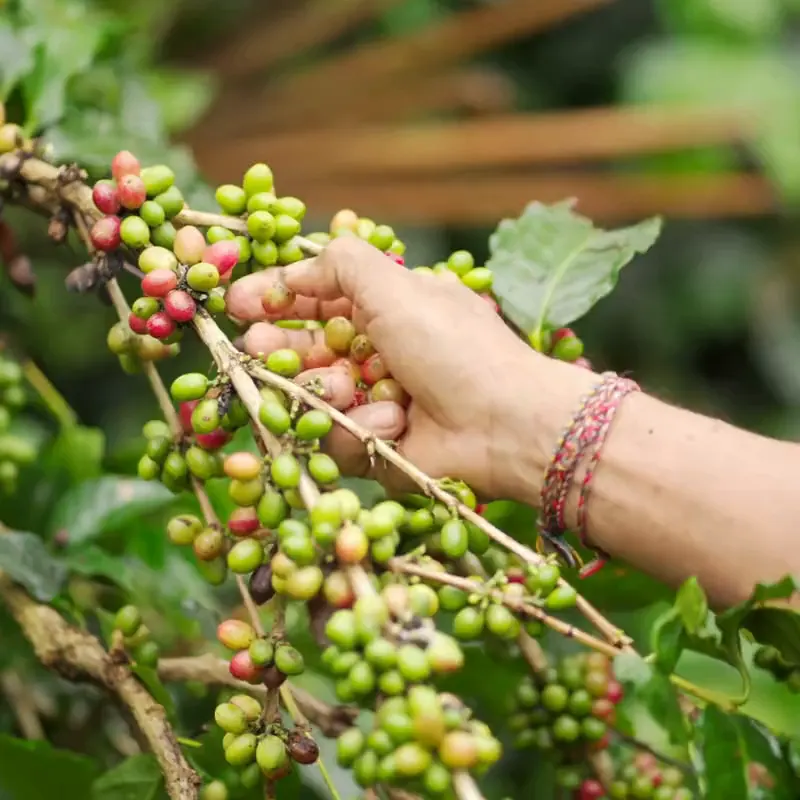
Two hands picking ripe red coffee cherries from a branch
Photo: shoot of August 2026Shows the work at origin, not a particular lot.

I · Growing and harvest

Station 3 of 14: Selective harvest

Cherry selection determines the raw material entering processing.

  1. InputCherries at different ripeness stages
  2. WorkSelective picking and sorting
  3. OutputSelected material for processing
Records and source

Ripe, unripe, overripe and damaged cherries can be assessed and separated. In his article on the Cerezómetro, Darveris Rivas describes a random sample on a grid of 100 cells, a ripeness scale and a target of more than 95 % of cherries within the target range. If the share is lower, the cherries are sorted again before processing.

What a record of this station can hold

  • Date, block and picking team
  • Ripeness distribution and faulty fruit
  • Time from harvest to processing

No measured ripeness distribution is available for the coffees on offer.

Source: Darveris Rivas, “Cerezómetro”, sehablacafe.com, 28.05.2020; Café y Ciencia catalogue

Read on: Checked cherry by cherry. · Café y Ciencia

Hands holding a refractometer to measure cherry juice
Photo: shoot of August 2026Shows the work at origin, not a particular lot.

I · Growing and harvest

Station 4 of 14: Ripeness and °Brix

A refractometer helps assess cherry juice. °Brix indicates soluble solids, not the later sugar percentage of roasted beans.

  1. InputRepresentative cherry juice sample
  2. WorkCalibrated refractometer reading and ripeness assessment
  3. OutputRecorded °Brix value with sample and temperature
Records and source

In the Cerezómetro method, Rivas uses a refractometer to set the ripeness point. A measurement needs representative cherries, a defined juice sample, a calibrated instrument and a recorded temperature. A sweet cup, a high °Brix reading and a chemically measured sugar content are different statements, each with its own sample, method and unit.

What a record of this station can hold

  • °Brix of the cherry juice, that is dissolved solids
  • Sample, instrument, temperature and date
  • Sugar only as a separate chemical analysis

No °Brix or sugar values are available for the coffees of the collection or the current lots.

Source: Darveris Rivas, “Cerezómetro”, 2020

Read on: Acidity, body and finish, explained · Café y Ciencia

II Processing Stations 05 to 07 · At origin

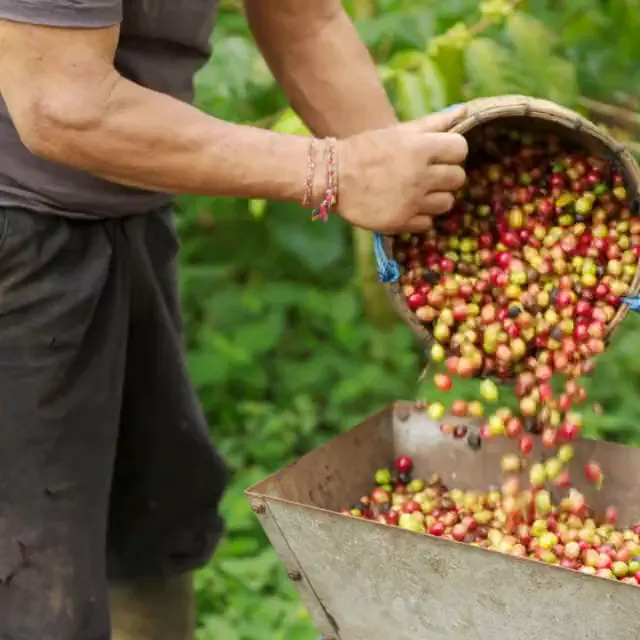
Pulping machine with coffee cherries
Photo: shoot of August 2026Shows the work at origin, not a particular lot.

II · Processing

Station 5 of 14: Processing and fermentation

Washed, natural, honey and distinctive must processes shape the path from cherry to green coffee.

  1. InputSelected cherries or depulped coffee
  2. WorkLot-specific processing and fermentation when applicable
  3. OutputCoffee ready for its defined drying stage
Records and source

Processing describes what happens to the fruit layers. Fermentation describes the microbial transformation during one stage of it. The ten method names of the Café y Ciencia collection are explained one by one on its page, together with what the catalogue does not state about them.

What a record of this station can hold

  • Time, temperature and pH
  • Vessel, atmosphere and substrates
  • Transition from the end of fermentation to the start of drying

Fermentation time, temperature and protocol are not stated for any lot. Washed or natural does not imply a particular recipe.

Source: Café y Ciencia catalogue

Read on: Café y Ciencia · Natural, washed and honey, explained

Gloved hands turning parchment coffee with a wooden rake on raised drying beds
Illustrative image (AI visualisation)Illustrates the step, not a photograph taken at origin.

II · Processing

Station 6 of 14: Drying

Drying brings processed coffee to a condition suitable for storage.

  1. InputCherries or parchment coffee with variable moisture
  2. WorkManaged moisture removal and regular checks
  3. OutputDried coffee with checked moisture and water activity
Records and source

The Café y Ciencia catalogue shows coffee on drying surfaces under a roof. Layer depth, turning, airflow and weather shape the process. Final moisture and water activity are measured separately; an even course helps to avoid different moisture levels within one lot. Beans that are too wet or have been rewetted can grow mould.

What a record of this station can hold

  • Date, weather and layer depth
  • Final moisture in % and water activity
  • Stabilisation and separate storage of lots

The catalogue gives no drying time or series of measurements. Measured moisture and water activity are shown with the reports of the individual samples.

Source: Café y Ciencia catalogue; analysis reports in the laboratory register; FAO, Arabica coffee manual

Read on: Natural, washed and honey, explained

Hands picking defective beans out of green coffee on a sorting table
Illustrative image (AI visualisation)Illustrates the step, not a photograph taken at origin.

II · Processing

Station 7 of 14: Hulling and sorting

After removing dried fruit layers or parchment, green coffee is sorted.

  1. InputDried coffee
  2. WorkHulling, sieving and removal of unwanted material
  3. OutputSorted green coffee sample
Records and source

Size, density, colour and visible defects are different sorting criteria, checked by screening, physical separation or visual selection. Alberto Gil’s selection describes how, after drying and hulling, the green beans are checked again for defects, broken beans and foreign matter. Badly adjusted machines can damage beans.

What a record of this station can hold

  • Screen distribution in %
  • Defects by type, count and equivalents
  • Colour, smell and uniformity

Sorting data from one sample do not apply to other coffees.

Source: Alberto Gil selection 2026, p. 9; FAO, Arabica coffee manual

Read on: Checked cherry by cherry. · Natural, washed and honey, explained

III Testing and cupping Stations 08 to 11 · In the lab

Hands holding a cup of green coffee in the lab, a meter beside it
Photo: Café y Ciencia catalogueShows the work at origin, not a particular lot.

III · Testing and cupping

Station 8 of 14: Physical laboratory

Moisture, water activity, density, screen distribution and defects describe the physical sample.

  1. InputIdentified green coffee sample
  2. WorkPhysical tests using documented methods
  3. OutputMeasurement report with units and test conditions
Records and source

Every measurement needs an unambiguous sample and lot number; test date, method, instrument and conditions make the result traceable. The Typica report signed by Darveris Rivas names as methods ISO standards, the Venezuelan standard COVENIN 1338-86 for sampling and the 2003 SCAA cupping protocol. These are test methods, not a certification.

What a record of this station can hold

  • Moisture in %, with method and date
  • Water activity and measuring temperature
  • Bulk density in g/L
  • Screen shares in % and test mass in g

A photograph of the laboratory proves neither an accreditation nor a type of instrument.

Source: Analysis report Typica, Finca Mucucay, 26.01.2026

Read on: Test reports on samples

Laboratory glassware with green coffee samples and instruments on a bench
Illustrative image (AI visualisation)Illustrates the step, not a photograph taken at origin.

III · Testing and cupping

Station 9 of 14: Chemical laboratory

Sugars, caffeine, pH and other constituents require chemical analysis.

  1. InputDefined sample: green, roasted or cherry juice
  2. WorkChemical determination of selected parameters
  3. OutputAnalytical values with method and reporting basis
Records and source

Darveris Rivas is a co-author of a study published in 2025 on three coffees from Mérida at different roast levels. It examined ash, crude fibre, caffeine, pH, fat and sugars as well as sensory quality. For a delivered coffee, every value needs its sample type, method, reference basis and unit; a value from roasted coffee is not a green coffee or cherry juice value. pH and perceived acidity are different statements.

What a record of this station can hold

  • Total sugar or individual sugars, with method
  • Caffeine and fat in % or mg/g
  • pH and acid content kept apart
  • Ash, crude fibre and analyses as required

The study is not an analysis of the coffees on offer. No lot related chemical values are available.

Source: Zerpa, Rivas, Hernández, Zambrano, Ciencia e Ingeniería 46 (2), 2025, DOI 10.5281/zenodo.15320514

Read on: Café y Ciencia · Acidity, body and finish, explained

The trier of a sample roaster with freshly roasted beans
Photo: Café y Ciencia catalogueShows the work at origin, not a particular lot.

III · Testing and cupping

Station 10 of 14: Sample roasting

Sample roasting provides a documented basis for sensory evaluation.

  1. InputGreen coffee sample
  2. WorkDocumented sample roast and cooling
  3. OutputComparable roasted sample for tasting
Records and source

A roast record can hold roast date, machine, batch size, time and temperature curve, first crack, end point, colour and weight loss. Comparable sample roasts help to judge coffees against each other. A roastery’s production profile comes later, for its machine, its batch size and the intended use.

What a record of this station can hold

  • Time, temperature and first crack
  • Colour and weight loss in %
  • Roast and cupping date

The documents on record contain no measured roast curve.

Source: Café y Ciencia catalogue

Read on: How roasters select green coffee

Cupping bowls, spoons and sample bags on a tasting table
Illustrative image (AI visualisation)Illustrates the step, not a photograph taken at origin.

III · Testing and cupping

Station 11 of 14: Cupping and evaluation

Aroma, flavour, acidity, mouthfeel and aftertaste describe the sensory experience of coffee.

  1. InputDocumented roasted sample
  2. WorkConsistent preparation and sensory assessment
  3. OutputCup description and, when available, a sample-linked score
Records and source

Cupping links a documented sample roast and preparation with a sensory evaluation. Score, cupper, date and protocol belong to the sample in question. The reports on record use two forms: Typica and Grupo MVC ten classic attributes, El Tirol, Brisas del Gil, Castillo and Festival eight affective attributes. Sensory sweetness is not an analytical sugar value.

What a record of this station can hold

  • Format, version and date of the protocol
  • Aroma, acidity, body and aftertaste
  • Score only with an assigned sample

The reports do not state the protocol version. Competition points belong to the competition coffee. How to read a score is explained in the knowledge article on segment and cup score.

Source: Analysis reports in the laboratory register; SCA, Coffee Value Assessment

Read on: Product segment and individual cup score · Test reports on samples

IV The way to the roastery Stations 12 to 14 · Through to Europe

Green coffee running from a chute into a jute sack
Photo: Café y Ciencia catalogueShows the work at origin, not a particular lot.

IV · The way to the roastery

Station 12 of 14: Packaging and storage

Packaging and labelling keep green coffee and its information together.

  1. InputApproved green coffee lot
  2. WorkPacking, labelling and controlled storage
  3. OutputProtected lot with accompanying information
Records and source

The Café y Ciencia catalogue shows coffee being filled into a sack. Packaging, net weight, lot number and labelling are confirmed by us for each delivery. Storage conditions, separate lots and accompanying documents are part of quality assurance; for roasted coffee, roast date, retail packaging and product labelling are added.

What a record of this station can hold

  • Farm, variety, process and lot
  • Net weight and packaging
  • Storage conditions and documents

We do not infer sack sizes or packaging types from a photograph.

Source: Café y Ciencia catalogue

Read on: Products

Stacked jute sacks with liners in a warehouse
Illustrative image (AI visualisation)Illustrates the step, not a photograph taken at origin.

IV · The way to the roastery

Station 13 of 14: Transport and handover

The packed green coffee lot reaches the roastery with its origin, processing and quality records.

  1. InputPacked lot and documents
  2. WorkShipping, receipt and reconciliation
  3. OutputAccepted green coffee lot at the roastery
Records and source

Shipping and goods receipt connect the goods with their documents: lot number, quantity, packaging and the agreed quality documents are checked against each other. At the roastery, packaging and lot identity are checked; a sample of the delivery can be compared with the approved sample.

What a record of this station can hold

  • Lot number, quantity and packaging
  • Origin, process and agreed analyses
  • Condition, spot check and release

Transport time, route and delivery terms are set out in each offer.

Source: Café y Ciencia catalogue; Alberto Gil selection 2026

Read on: Products

Freshly roasted beans in the cooling sieve with the stirring arm
Still: LOS ANDES roasted coffee filmShows the work at origin, not a particular lot.

IV · The way to the roastery

Station 14 of 14: Roasting and final packaging

Production roasting develops the profile for the intended brew. Cooling, quality checks and retail packaging complete the journey.

  1. InputAccepted green coffee lot
  2. WorkProduction roast, cooling, checks and packaging
  3. OutputLabelled roasted coffee
Records and source

The roastery develops the profile for machine, batch size and use. Time, temperature, energy input, airflow, first crack and end point belong in the production record. Roasting changes composition and aroma; Maillard reactions and the breakdown of sugars contribute to this. After cooling come checking, packaging and labelling with roast date and product data.

What a record of this station can hold

  • Time, temperature, energy and air
  • Colour, weight loss and cup profile
  • Protection, roast date and product data

For Filterkaffee and Espresso Crema, the data sheets LA-1002 and LA-1001 apply: drum roasted, medium (3/5).

Source: Data sheets LA-1001 and LA-1002

Read on: Roasted coffee · How roasters select green coffee

History

Three hundred years, with a gap

In full in the knowledge centre
  1. 1730s

    The first sowing

    The Jesuit José Gumilla records that he sowed coffee at the Orinoco missions himself and raised it.

  2. 1783

    The first plantation

    The first organised planting is laid out in the gardens of Chacao; in the nineteenth century it grows into an export economy.

  3. 2014/15

    The collapse

    For 2014/15 the USDA reports the sharpest production fall in at least fifteen years, caused mainly by a coffee rust outbreak.

The harvest at origin.

  1. Growing and harvest

    Picking is done by hand and selectively. On the farm, cherries are measured and selected before they go into processing.

  2. Processing and selection

    The five current lots are washed: pulped, washed and dried under control. Café y Ciencia also works with natural, honey and its own fermentation processes.

  3. Profile, samples and enquiry

    Every lot is described with its cupping score; samples are available on request. Delivery is in 60 kg sacks in GrainPro.

    EXW Venezuela · CFR/CIF · DAP Germany

Selection

Checked cherry by cherry.

Selection continues after the harvest. The pictures from Alberto Gil’s selection show how a cherry is checked, opened and sorted out when it is damaged.

Harvested cherries, Mucucay Coffee Farm, Mérida · Café y Ciencia
  1. 01Check

    Fruit skin and visible damage are inspected.

  2. 02Open

    The condition inside becomes visible.

  3. 03Sort out

    A damaged spot leads to rejection.

Before fermentation

According to the selection, cherries found to be damaged, diseased or spoiled are sorted out and do not enter the fermentation batch.

At the green coffee

After drying and hulling, the green beans are checked again for defects, broken beans and foreign matter.

Alberto Gil selection 2026. The cause of the damage shown cannot be determined from the photograph. A physical defect, a sensory fault and a mould analysis are different checks.

Read on: Station 07 · Hulling and sorting · Station 08 · Physical laboratory · Natural, washed and honey, explained

The route to Europe

  1. Farm

    Selective picking of ripe cherries at origin.

  2. Processing

    Washed or natural, drying, hulling and sorting.

  3. 60 kg sack

    Marked per lot, with a protective liner depending on the lot.

  4. Export

    EXW Venezuela · CFR/CIF · DAP Germany

  5. Berlin

    LOS ANDES EUROPE GmbH, Berlin

  6. Your roastery

    Sample, roast profile, quote.

Sources

The historical statements on this page rest on the sources below. Where our own catalogue is the source, it says so.

  1. 1741

    José Gumilla

    El Orinoco ilustrado, y defendido, historia natural, civil y geographica de este gran río

    Madrid

  2. 2015

    USDA Foreign Agricultural Service

    Coffee Annual: Venezuela

    GAIN report, Caracas

    fas.usda.gov
  3. 2024

    Fundación Empresas Polar

    Diccionario de Historia de Venezuela: entry “Café”

    BiblioFEP

    bibliofep.fundacionempresaspolar.org
  4. 2026

    International Coffee Organization

    World Coffee Statistics Database

    ico.org